A letter from Facilities Advisory Committee Members
Updated: Jan 3
November 24, 2025
Re: Facilities Advisory Committee
Dear Dr. Glasner and Board members,
Based on David’s October 30th email, we understand the school district does not intend to continue the work of the Facilities Advisory Committee (FAC) beyond the meeting scheduled for December 1st. As members, we concur that it is time for this body to be dissolved. In its current form, the FAC has for some time ceased to be a meaningful tool for community engagement. It does not provide an avenue to communicate with the broader Shaker community, nor has it been particularly successful as a tool to effect improvements in communications, project management, or project quality.
Nevertheless, we feel that two-way engagement with the community is critical to the success of the facilities project. This is indeed Shaker’s largest public facilities project in generations, with significant financial resources devoted to the effort. Shaker residents have entrusted the Board and District administration with stewardship of this work, and deserve professional project management, quality outcomes consistent with community input and values, and the transparency necessary to verify those results.
With that in mind, this letter re-caps past FAC experiences both for the benefit of incoming members-elect as well as to refresh the memories of continuing administrators and board members, then delineates suggestions for improvements:
Our FAC experience and shortcomings in meaningful partnership.
Lessons from the Ludlow project: missed community engagement opportunities, schedule delays, and quality concerns, highlighting risks to the overall facilities project success that may continue to future work if not corrected.
Project management concerns and recommendations emphasizing the need for dedicated Owner representation, consultants or staff with construction industry training and experience commensurate with the substantially increased scale and complexity of the work to come.
More effective future community engagement strategies, to include plans for each project with defined timelines and outcomes, as well as more structured and deliberate approaches to transparency, making detailed project information readily available to the public.
The facilities work can still benefit from community expertise. While we believe the current FAC structure and approach is no longer useful, there are other ways to make use of the wisdom in our broader community.
This letter is offered with the intent of creating a more successful facilities plan, both in ensuring the resulting structures best meet the learning needs for future generations of students, and in strengthening the relationship between the schools and community members, increasing the trust and credibility that are so important to our mutual success. But urgent action is needed to steer project management and public communications to a more successful direction.
Facilities Advisory Committee Background
It’s worth reflecting on the initial organization of the FAC. Over 30 members selected to provide broad representation of the Shaker community in age, neighborhood, background, and relationship to the schools. And including a variety of experience useful to the effort: parents with relationships to specific schools, teachers knowledgeable in the educational issues relevant to building functions, and members with professional expertise useful for enhancing the end result. All unified in the hopes that the group would provide meaningful input in steering the facilities work to reflect the needs and values of the entire community.
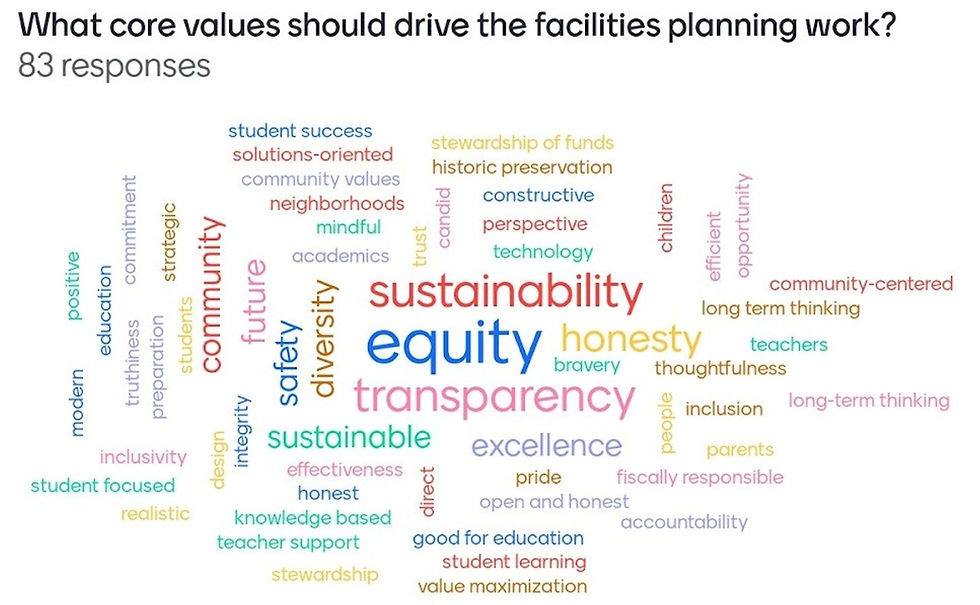
At that very first meeting of the FAC, we engaged in an exercise to define the priorities for the work of the group. Clear priorities emerged: sustainability, equity, and transparency, goals ratified by the District as aims they would internalize for the work of the facilities plan.
We also recall a question posed at that initial meeting: Did the District want the FAC to be a way to ‘check the box’ saying the community had been consulted? Or did it want input that might challenge assumptions, and refine and improve outcomes? The answer from the superintendent was clear; the FAC was not to be a rubber stamp.
Yet in our experience, that promise has been unfulfilled more often than not. Our perception is that information provided has been relatively limited, answers to probing questions regularly deferred and left unanswered, and suggestions for improvements left unimplemented without explanation. Generally the FAC was used as an arms-length focus group rather than engaged and leveraged as a meaningful partner in the success of the process and projects.
Lessons from the Ludlow Early Learning Center
Oddly, the Ludlow Pre-K project was initially excluded from the FAC’s purview. However, as the first project to be constructed, involvement of the FAC was unavoidable and it’s important that the challenges encountered during this project inform the work to come.
Community engagement: Engagement regarding project design and impacts was limited to meetings with the Ludlow Community Association, a small and under-resourced group with limited reach and not fully representative of the community. Despite repeated pleadings, project outreach was never extended beyond the two or three dozen LCA members that attended meetings. It remains perplexing why stronger efforts weren’t made when “Equity” was identified as a goal of the Facilities project and the FAC.
Schedule: During project design phases, it quickly became apparent that the schedule was behind what members of the FAC expected to be necessary for timely project completion. Schedule concerns were flagged by the FAC as early as May 2024 in writing and via in-person meetings with the superintendent and board members, predicting challenges to timely completion. No changes appear to have been made to recover the schedule.
The project commenced primary construction work in December 2024 targeting an eight-month schedule, anticipating completion on July 21, 2025 to allow time for an orderly move-in and resolution of minor open items. As we all know, the partial completion minimally necessary for initial occupancy was not achieved until mid-September, a delayed opening date negatively impacting preschool families. We understand approximately $600,000 of work remained uncompleted at that time.
Furthermore, construction continues to this day, with significant scope elements still missing. Interior and exterior construction had continued this month during school hours distracting young learners. Put another way, the completion of Ludlow has already exceeded its original timeline by 50 percent, and no endpoint will be reached until winter break at the soonest.
Project quality: While FAC members do not have transparency into the details of construction and have not had the opportunity to tour the building interior in its current state, there are conditions visible on the building exterior that raise questions about the quality of design detailing and/or the care taken in construction. If by extrapolation similar oversights have occurred in the interior or in building systems, that would be concerning indeed. As an example, it’s been reported that restrooms primarily used by preschoolers are fitted with full-sized plumbing fixtures mounted at heights intended for adults, which if true is an alarming oversight considering the building’s intended use.
Site design: It’s heartening to see the enlarged Ludlow playground and its community benefits touted as a success in the 2025-26 Measuring What Matters report. Yet it’s important to remember how hard the District fought this result. Without significant advocacy efforts by FAC members to the board and to City approvals bodies over many months, we would instead have seen a substantially larger parking lot[1], a minimal playground, and the loss of significant numbers of legacy trees, a much poorer result for Pre-K kids and the neighborhood alike. Robust engagement makes projects better. The process would be easier for all if the District embraced engagement as a partnership rather than working in opposition to the community.
Neighborhood property damage: Picture a friend relaying the following scenario. Five months ago, their next-door neighbor damaged property throughout the neighborhood. They have not apologized, nor have they accepted or denied responsibility. Despite repeated requests, they have not provided a plan or timeline for making repairs – their responses to communication are terse and uninformative. Furthermore, they ask your friend for money twice a year, and they’ve indicated they’ll be asking for more in the future. What’s your mental picture of that next-door neighbor and your opinion of their character?
Yet the scenario above accurately describes damage to Ludlow sidewalks and property, unrepaired and unaddressed since it occurred in the early summer. One can make a case that the school district’s treatment of neighbors to school facilities is important for maintaining goodwill and credibility. But one can also make a case that the District should simply act ethically as a good neighbor. In either case, the District’s behavior is unacceptable - we wouldn’t tolerate it from our own neighbors. Yet the District seems to minimize this as trivial and not meriting attention or effort. Simply put – if this is just a small thing, why wasn’t it then just fixed when the damage occurred?
The difficulties in the Ludlow design and construction work have often been excused as a “learning curve”. This is reasonable framing if one is taking up a new hobby – trying one’s hand for the first time at playing the trombone or refinishing furniture. But this is wholly unacceptable for a multimillion dollar public investment, which should be professionally managed from day one. If we missed other District targets by a similar 50% magnitude (budgets? graduation rates?) it would be state-wide news. What have been the impacts on project quality and cost resulting from months of evening and weekend overtime? How has the project team and administration been held accountable for project mis-steps?
We are now at the beginning stages of Woodbury, a substantially larger project, perhaps five times the size and cost of Ludlow. It is also orders of magnitude more complex in every way – more challenging historic renovation issues, much larger new construction, tricky grading and site issues, and the inclusion of program elements like the auditorium and natatorium that require sophisticated envelopes and building systems.
With Woodbury’s additional complexity, we ask: what specific changes have been made to the school district’s project management capabilities and approach in order to ensure the successful execution of this project and the upcoming elementary school projects that will be designed and developed concurrently?
Recommendations for project management
A third-party project manager/owner's representative should be hired by the District for the remainder of the project. This was a recommendation offered during the first FAC meeting and repeated numerous times since then. The current in-house supervision is led by an individual who has exposure to the construction industry, but no deep experience or formal training that we are aware of. The District would not fill significant leadership roles elsewhere based solely on a previous exposure to the educational environment - standards for certification for building principals and similar administrative positions are rigorous and rightly so. Qualifications for construction project management should be no different.
The Shaker school buildings have complex requirements due to their age, their neighborhood contexts, and the challenges in creating appropriate additions. Any experienced property developer would dedicate a team of full-time staff to managing projects of this magnitude. Meanwhile the Assistant Superintendent has a broad load of other responsibilities. It is not fair to him or to the taxpayers to place this responsibility on him without professional assistance. A $188 million dollar project is not a side hobby, it requires someone's full attention.
Recognize that design oversight is needed. The design of building sites and exteriors require city approvals. Those public processes have significantly benefitted the outcomes for both Ludlow and Woodbury. Initial design efforts were substantially improved to create better results for both the District and the community, but only because the city approval hurdles needed to be crossed. Even so, it has been confirmed that the building design of Woodbury required the District to retain a third-party architect outside of GPD and RPMI in order to help refine the design to a level that the Planning Commission could accept.
However, the only approval needed related to a facility’s interior configuration, detail, and specifications is minimum building code compliance. Yet there is no reason to believe that these other aspects of the project design would not also benefit from another set of eyes.
Commission a peer review of construction documents. We suggest the District retain outside expertise to review drawings and specifications at the +/-90% completion stage and provide comments and recommendations. Such peer reviews are common in the industry on much smaller projects, as are reviews by specialty firms such as building envelope and accessibility consultants. Given the magnitude and complexity of Woodbury in particular, it is easy to imagine how avoiding even a few errors could pay back this small investment in multiples. Building defects can have ripple effects, creating additional operating costs and interrupting the operation of the building after it is occupied by students. A peer review is cheap insurance. Given the project schedule, this requires urgent action.
Demand measurable deliverables for sustainability goals. The District made a prudent investment in commissioning Emerald Built Environments to provide a sustainability master plan. However, that assessment was a broad, high-level effort that requires detailed follow-up if benefits are to be achieved. A LEED checklist by itself does not guarantee improved outcomes. The District must focus on setting performance targets that are meaningful, then track their implementation and performance not only through construction but also after occupancy.
Good sustainability practice is often thought of in terms of energy performance, which can indeed yield benefits to the bottom line in reduced operating costs. However, as the board is well aware, staff costs are the largest portion of the budget. Certain sustainability practices have been demonstrated to improve staff health, productivity, and retention, and can do so in ways that dwarf the potential of direct facility impacts. Most importantly, there are potential benefits to student performance - we should not miss these opportunities.
Recommendations for two-way community engagement
An outreach and communication plan for Woodbury should be put in place immediately. Some decisions are set in stone at this point but there is still work to do. There has not been a single event for open, public two-way dialog on the design of Woodbury. While the major components of design are largely fixed at this point, getting feedback and input from the community is still important and could create a better building. The plan should have clear dates, audiences, subject material, and outcome/deliverables reported to the Board.
Ludlow should still be shared with the community. The initial open house was scheduled during most people’s working hours, and the building was incomplete. This is a missed opportunity to build goodwill for the schools, and Ludlow could host a weekend event that would also be an opportunity to share Woodbury design progress and receive input.
No work should begin on additional buildings until a clear, specific plan is in place for public outreach, communication, and involvement on each specific building and approved by the Board. These plans should contain actual events with set dates, agendas, deliverables/feedback sought and not just be a "commitment to more outreach". It also seems that clarity regarding the final sequence, scope, and timing of the elementary school projects is overdue.
A web page should be set up immediately to share files, reports, and information to the public. The existing Facilities Project page has always been woefully inadequate and consistently out of date. The District should make a commitment to full transparency. Project submittals should be posted in a timely manner ahead of the ABR and P&Z meetings to allow the community to review and process the information and provide thoughtful opinions and feedback to the relevant boards. These files should stay online and accessible throughout the entire Facilities project so the public can track iterations, and should also include project cost and schedule data. The city knows how - follow their example.
Follow up and public engagement and discussion at the end of each project describing the final financial, scheduling, and programmatic outcomes.
Thoughtful community questions deserve serious and timely answers. At present, the District picks and chooses which questions it would like to respond to. Others are ignored. Not every suggestion from the community must be implemented, but an explanation of the decision rationale should be provided. The District should commit to responding to questions within a week. Responding vaguely with “We’ll discuss it” or “We’re looking into this” then never following up is unprofessional and unacceptable.
Recommendations for a future advisory structure
Reorganize the committee to work under and advise the Board on the Facilities Plan. We understand other committees (Policy, Finance & Audit) are advisory to the Board rather than the Administration. We believe the board and the project would benefit from a similar structure. We suggest there is a benefit in separating technical guidance and community engagement aspects. Shaker has many individuals with substantial expertise in architecture, engineering, and the construction industry, and also many valuable viewpoints that should be heard regarding community needs. These are not always the same persons or process.
We also recommend establishing committees focusing on sustainability and equity. As seen in the word cloud from the first FAC meeting, these are shared values among the committee members and the community at large. The District attempted to establish a Sustainability Committee but it had the same undefined goals and oversight as the FAC and has not produced tangible outcomes. And as we saw during the discussions of the recent levy, equity is an ongoing issue that needs to be addressed. Both of these committees should also inform the ongoing facilities project with the FAC.
Find ways to incorporate many of the ideas and suggestions from the FAC that have fallen by the wayside. Meaningful incorporation of public and local art, beautiful landscaping and outdoor learning spaces with a focus on local, native plants, a solid commitment to preservation and architectural salvage/reuse, better and more robust coordination with the other components of the City Government, and concrete plans for facilities sharing are among some of the many ideas brought up by the FAC that were either ignored or set aside with no concrete plan for follow-up. It is particularly frustrating to see the occurrence of FAC meetings touted in weekly facilities update emails as if they were an end to themselves, while the substance of the discussions are elided and the concerns and suggestions from the FAC are ignored. As committee members, this has left us feeling used rather than useful.
The Facilities Project should have been enjoyable and a way to bring our community together and it has largely been the opposite since the beginning. We encourage both the Board and the Administration to always be looking for ways to unite the community around these projects even if that means tapping the brakes when needed. We recognize costs inflate over time. To us, that suggests public partnership and transparency in planning work needs to start sooner. Schedules must include realistic timetables for public input, quality design, and the necessary reviews and approvals. Given the choice, we believe it is better to get it right than get it fast.
To end on a positive note, the Facilities Advisory Committee was originally meant to be a cross section of Shaker Heights and it succeeded in that. It has been an opportunity for us on the committee to make connections and develop relationships and friendships with neighbors that we may otherwise have never met. Not everyone on the committee felt comfortable signing on to this letter but we have found that, even when we don’t agree, we were all operating with the same set of values and commitment to making Shaker Heights better.
Thank you,
Richard Cissell
Kevin Dreyfuss-Wells
Rick Freer
Lynn Lilly


Was there a response from the board or administration? Who received this letter? Thank you for all this important information and for continuing to press for the implementation of these suggestions which should already be part of the plan and process.
I experienced the same frustration as a member of the Parent Advisory Committee formed in the summer of 2020 to inform the plans for how the schools would operate during COVID. We were apparently there to only respond to the plans presented and not to offer insight, suggestions, or share the lived experiences of parents also navigating COVID. Eventually, district leadership of the committee changed and our input was at least heard if not incorporated into the final plan.