Lomond Elementary
Originally Constructed: 1928
Original Architect: Charles Schneider
Additions: 1954, 1971
Building History:
Lomond has been in continuous use as an elementary school since its initial construction.
Costs for renovation of Lomond are funded by a portion of the bond levy approved by voters on the November 2023 ballot (Issue 13).
2025 Enrollment: 448 students (grades K-5)
(75 per grade average)
2024 Enrollment: 372 students (grades K-4)
(74 per grade average)
2019 Enrollment: 374 students
(75 per grade average)
2015 Enrollment: 428 students
(86 per grade average)
2024 Bldg. Capacity: 521 students
Playground: The playground area is approx. 33,400 sq. feet (25,400 sq. ft. playground, 8,000 sq. ft. paved play area).
Other Site amenities: The Lomond property includes generous play field areas with two baseball diamonds with backstops as well as additional open field areas available for community use.
The District maintains a page with information about the elementary school renovations here.
Renovation Architect: GPD Group*
Architectural/engineering services and reimbursable expenses are performed under a $12 million blanket contract for facilities master plan work.
*The GPD Group is performing the project architectural work in partnership with RPMI. They have divided responsibilities for the elementary schools between the two firms; GPD has the primary responsibility for Lomond Elementary.
Construction Manager: Gilbane Building Co.
Building Area: 63,023 sq. ft.
Site Area: 8.75 acres
Project Construction Budget:
Current budget: $15,653,762
Unit Cost: $248 per sq. ft. total project
Project Schedule:
Design Start: January 2026
Design approvals: TBD - fall '26?
Drawings complete: December 2026
Construction Start*: June 2027
Anticipated Revised Start June 2028
Scheduled Finish: July 2028
Anticipated Revised Finish July 2029
*Lomond students will be relocated to the current Shaker Middle School campus during the 2027-28 school year for the construction period, sharing the building with Mercer students
School Start in Renovated Building
Scheduled: August 2028
Anticipated Revised School Start August 2029
Shared facilities: Design approaches to allow community use of Lomond spaces have not yet been publicly presented.
Key Project Issues
The elementary schools have many issues in common. Refer to the Schools page on this website for further information regarding the intended project scopes as well as issues that may require exploration.
Building Foundation Concerns
While investigating existing conditions at the building, project structural engineers discovered deteriorated conditions in the area of the northeast corner of the building. The building foundation appeared damaged, with masonry crumbling or missing. The District closed the building to students February 18 & 19. Four classrooms and several offices were relocated, and two entrances closed.
Persons familiar with the building have reported that drainage and water intrusion problems have been present near this area for a number of years.
Accessibility /
New Elevator
To be more usable by students of all physical abilities, Lomond School will require modifications to facilitate easier building access. Lomond is the only Shaker School without an elevator, and the project includes the addition of a new elevator shaft. The Main entrance and playground access door require ADA-compliant modifications.
Integrating accessible entries and elevators into older school buildings can be challenging, and requires skillful design to do so in a way that makes them easily usable to all while respecting the character of the building.
Community engagement
Design work is just beginning for the Lomond project. A plan for engaging with the community was introduced at the 1.13.2026 Board of Education meeting.
An initial "Meet the Architects" event was held on February 12, 2026 at Lomond. Architects presented information on the project schedule and scope, with about 15 neighbors attending.
Tree protection
The Lomond site is lined with large, mature legacy trees that provide shade to the school and surrounding streets. For these trees to remain for the next generation, they will need to be protected and cared for during the construction process.
Previous work at the Ludlow and Woodbury projects has not always followed best practices to retain and protect trees. This project may require advocacy for better care.
Lomond rear entry replaced
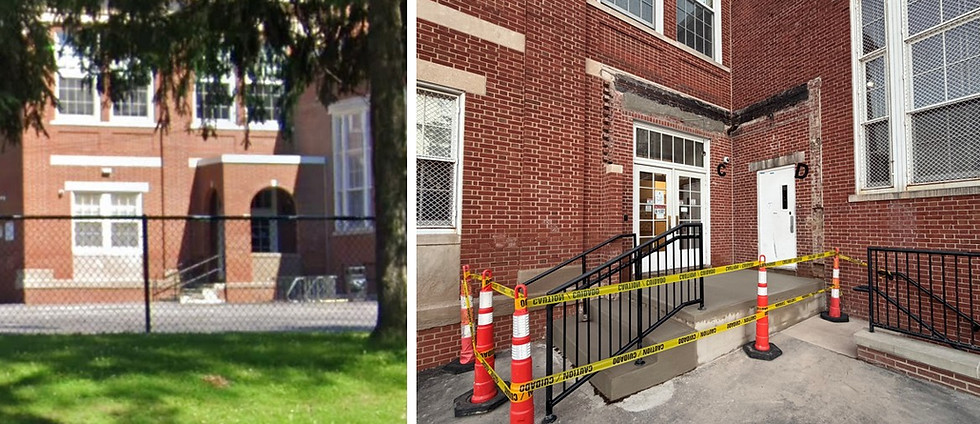
08.17.2026 - On the left, we see the rear entry as it looked previously. On the right, a view of the same entrance on the first day of school.
Several building code and potential safety problems are visible: the landing steps down immediately at the threshold of the doors when code requires it to be at the same level as the interior floor. The stair risers are of uneven heights ranging from 7 to 9-1/2 inches--two exceed the code's maximum allowable height. (Ohio Building Code 1010.1.4, 1011.5.2, 1011.5.4). These irregularities can increase the risks for trips and falls. There's no clear reason that the new stairs could not have been designed to be code-compliant, this seems to be the result of simple carelessness.